

How To Spiritually Play A Digerido Youtube
 A, B and C: traditionally made didgeridoos. | |
| Other names | Didjeridu, yiḏaki, mandapul, mako, etc. |
|---|---|
| Classification |
|
| Hornbostel–Sachs nomenclature | 423.121.11 (end-blown straight tubular natural trumpet without mouthpiece) |
| Playing range | |
| Written range: central typically A2 to G3 | |

A didgeribone, a sliding-type didgeridoo.
The didgeridoo (; also spelt didjeridu, amidst other variants) is a wind musical instrument, played with continuously vibrating lips to produce a continuous drone while using a special breathing technique called circular breathing. The didgeridoo was developed past Aboriginal peoples of northern Australia at least 1,500 years ago, and is now in apply effectually the world, though nonetheless nigh strongly associated with Ethnic Australian music. The Yolŋu name for the instrument is the yiḏaki , or more recently by some, mandapul ; in the Bininj Kunwok language of W Arnhem Land it is known equally mako .[1]
A didgeridoo is normally cylindrical or conical, and tin mensurate anywhere from 1 to 3 m (3 to 10 ft) long. Well-nigh are around 1.2 m (four ft) long. By and large, the longer the instrument, the lower its pitch or key. Flared instruments play a higher pitch than unflared instruments of the aforementioned length.
History [edit]
There are no reliable sources of the verbal age of the didgeridoo. Archaeological studies suggest that people of the Kakadu region in Northern Australia have been using the didgeridoo for less than one,000 years, based on the dating of stone art paintings.[2] A articulate rock painting in Ginga Wardelirrhmeng, on the northern edge of the Arnhem Land plateau, from the freshwater period[3] (that had begun 1500 years agone)[4] shows a didgeridoo player and two songmen participating in an Ubarr ceremony.[5] It is thus thought that information technology was developed by Aboriginal peoples of northern Australia, possibly in Arnhem Country.
T. B. Wilson'due south Narrative of a Voyage Round the Globe (1835) includes a cartoon of an Aboriginal human from Raffles Bay on the Cobourg Peninsula (near 350 kilometres (220 mi) east of Darwin) playing the instrument. Others observed such an instrument in the aforementioned expanse, fabricated of bamboo and near 3 feet (0.nine chiliad) long. In 1893, English palaeontologist Robert Etheridge, Junior observed the use of "three very curious trumpets" fabricated of bamboo in northern Australia. There were then two native species of bamboo growing forth the Adelaide River, Northern Territory".[six]
According to A. P. Elkin, in 1938, the instrument was "just known in the eastern Kimberley [region in Western Australia] and the northern third of the Northern Territory".[vii]
Etymology [edit]
The proper name didgeridoo is not of Aboriginal Australian linguistic origin and is considered to be an onomatopoetic word. The earliest occurrences of the discussion in print include a 1908 edition of the Hamilton Spectator referring to a "'did-gery-practise' (hollow bamboo)",[8] a 1914 edition of The Northern Territory Times and Gazette,[ix] and a 1919 issue of Smith's Weekly, in which it was referred to as a "didjerry" and was said to produce the sound "didjerry, didjerry, didjerry and so on ad infinitum".[ten]
A rival explanation, that didgeridoo is a abuse of the Irish gaelic Gaelic phrase dúdaire dubh or dúidire dúth , is controversial.[xi] Dúdaire or dúidire is a noun that, depending on the context, may mean "trumpeter", "hummer", "crooner" or "puffer", while dubh means "blackness", and dúth means "native".
Other names [edit]
There are numerous names for the instrument amongst the Aboriginal peoples of northern Commonwealth of australia, none of which closely resemble the discussion "didgeridoo" (meet below). Some didgeridoo enthusiasts, scholars and Aboriginal people advocate using local language names for the musical instrument.[12]
Yiḏaki (transcribed yidaki in English, sometimes spelt yirdaki) is one of the near commonly used names although, strictly speaking, it refers to a specific type of the instrument made and used by the Yolngu peoples of north-due east Arnhem Land.[13] Some Yolngu people began using the discussion mandapul after 2011, out of respect for the passing of a Manggalili human who had a proper name sounding similar to yidaki.[14]
In west Arnhem Land, information technology is known every bit a mako, a proper name popularised past virtuoso histrion David Blanasi, a Bininj human, whose linguistic communication was Kunwinjku, and who brought the didgeridoo to globe prominence.[seven] Yet the mako is slightly different from the Yiḏaki: usually shorter, and sounding somewhat different – a slightly fuller and richer audio, simply without the "overtone" annotation.[xiv] [xv] [7]
There are at to the lowest degree 45 names for the didgeridoo, several of which suggest its original construction of bamboo, such equally bambu, bombo, kambu, and pampu, which are still used in the lingua franca by some Aboriginal people. The following are some of the more common regional names.[6]
| People | Region | Local name |
|---|---|---|
| Anindilyakwa | Groote Eylandt | ngarrriralkpwina |
| Arrernte | Alice Springs | ilpirra |
| Djinang (a Yolngu people) | Arnhem Country | yiḏaki |
| Gagudju | Arnhem Land / Kakadu | garnbak |
| Gupapuygu | Arnhem State | yiraka |
| Iwaidja | Cobourg Peninsula | artawirr |
| Jawoyn | Katherine / Nitmiluk / Kakadu | gunbarrk |
| Kunwinjku | Arnhem Land / Kakadu | mako[sixteen] |
| Mayali | Alligator Rivers | martba |
| Ngarluma | Roebourne, W.A. | kurmur |
| Nyul Nyul | Kimberleys | ngaribi |
| Pintupi | Central Commonwealth of australia | paampu |
| Warray | Adelaide River | bambu |
| Yolngu | Arnhem State | mandapul (yiḏaki) |
Description and construction [edit]
A didgeridoo is ordinarily cylindrical or conical, and can measure anywhere from 1 to 3 m (3 to 10 ft) long. Most are around 1.2 one thousand (4 ft) long. Generally, the longer the instrument, the lower its pitch or central. Nevertheless, flared instruments play a higher pitch than unflared instruments of the same length.[17]
The didgeridoo is classified as a wind musical instrument and is similar in form to a straight trumpet, just made of wood. It has likewise been called a dronepipe.[18]
Traditional [edit]

A wax mouthpiece tin soften during play, forming a better seal.
Traditional didgeridoos are usually made from hardwoods, specially the various eucalyptus species that are owned to northern and central Australia.[19] By and large the principal body of the tree is harvested, though a substantial co-operative may be used instead. Traditional didgeridoo makers seek suitably hollow live trees in areas with obvious termite activity. Termites attack these living eucalyptus trees, removing only the dead heartwood of the tree, as the living sapwood contains a chemical that repels the insects.[20] Various techniques are employed to notice trees with a suitable hollow, including knowledge of landscape and termite activity patterns, and a kind of tap or knock test, in which the bark of the tree is peeled back, and a fingernail or the blunt end of a tool, such as an axe, is knocked confronting the wood to determine if the hollow produces the right resonance.[21] Once a suitably hollow tree is found, it is cut down and cleaned out, the bawl is taken off, the ends trimmed, and the outside is shaped; this results in a finished instrument. A rim of beeswax may be practical to the mouthpiece end.
Mod [edit]
Non-traditional didgeridoos can be made from native or non-native difficult woods (typically carve up, hollowed and rejoined), glass, fibreglass, metal, agave, dirt, resin, PVC piping and carbon fibre. These typically have an upper inside bore of around iii centimetres (i.two in) down to a bell end of anywhere between v and 20 centimetres (2 and eight in) and have a length corresponding to the desired central. The end of the pipe can be shaped and smoothed to create a comfy mouthpiece or an added mouthpiece tin be made of any shaped and smoothed material such as rubber, a safety stopper with a pigsty or beeswax.
Mod didgeridoo designs are distinct from the traditional Australian Aboriginal didgeridoo, and are innovations recognised past musicologists.[22] Didgeridoo blueprint innovation started in the late 20th century, using non-traditional materials and non-traditional shapes. The practice has sparked, however, a adept deal of contend (aesthetic, ethical, and legal) among indigenous practitioners and non-indigenous people.[23] [24]
Decoration [edit]
Didgeridoos tin can be painted by their maker or a defended artist using traditional or mod paints while others retain the natural forest grain design with minimal or no decoration.
Playing [edit]
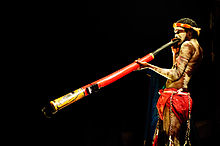
A didgeridoo can be played only past producing a vibrating sound of the lips to produce the basic drone. More advanced play involves the technique known as circular breathing. The circular breathing technique requires breathing in through the nose whilst simultaneously using the muscles of the cheeks to compress the cheeks and expel stored air out of the mouth. Past employ of this technique, a skilled thespian can replenish the air in their lungs, and with exercise can sustain a note for as long as desired. Recordings exist of modern didgeridoo players playing continuously for more than than forty minutes; Marker Atkins on Didgeridoo Concerto (1994) plays for over 50 minutes continuously. While circular breathing does eliminate the need to finish playing due to oxygen replenishment restrictions being obviated, discomfort might even so develop during a period of extended play due to chapped lips or other oral discomfort.
The didgeridoo functions "...as an aural kaleidoscope of timbres"[26] and "the extremely difficult virtuoso techniques adult by proficient performers find no parallel elsewhere."[26]
The didgeridoo virtuoso and composer William Barton has expanded the role of the musical instrument in the concert hall both with his own orchestral and chamber music works and with those written or arranged for him by prominent Australian composer Peter Sculthorpe.
Physics and operation [edit]
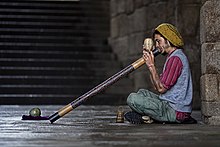
Didgeridoo street histrion in Spain
A termite-bored didgeridoo has an irregular shape that, overall, usually increases in diameter towards the lower cease. This shape means that its resonances occur at frequencies that are non harmonically spaced in frequency. This contrasts with the harmonic spacing of the resonances in a cylindrical plastic pipe, whose resonant frequencies autumn in the ratio 1:3:5 etc. The 2d resonance of a didgeridoo (the note sounded by overblowing) is usually around an 11th higher than the fundamental frequency (a frequency ratio of 8:iii).
The vibration produced past the actor's lips has harmonics, i.e., it has frequency components falling exactly in the ratio 1:2:3 etc. Yet, the non-harmonic spacing of the instrument's resonances means that the harmonics of the fundamental annotation are not systematically assisted by musical instrument resonances, as is commonly the case for Western air current instruments (e.g., in the low range of the clarinet, the 1st, 3rd, and fifth harmonics of the reed are assisted by resonances of the bore).
Sufficiently potent resonances of the vocal tract can strongly influence the timbre of the musical instrument. At some frequencies, whose values depend on the position of the role player's tongue, resonances of the vocal tract inhibit the oscillatory menstruum of air into the instrument. Bands of frequencies that are not thus inhibited produce formants in the output sound. These formants, and especially their variation during the inhalation and exhalation phases of round breathing, give the musical instrument its readily recognizable sound.[27] [28]
Other variations in the didgeridoo's sound can exist fabricated by adding vocalizations to the drone. Nearly of the vocalizations are related to sounds emitted past Australian animals, such as the dingo or the kookaburra. To produce these sounds, the players apply their vocal folds to produce the sounds of the animals whilst continuing to blow air through the musical instrument. The results range from very loftier-pitched sounds to much lower sounds involving interference between the lip and vocal fold vibrations.[29] Adding vocalizations increases the complication of the playing.
In popular civilization [edit]
Charlie McMahon, who formed the group Gondwanaland, was ane of the kickoff non-Aboriginal players to gain fame as a professional didgeridoo player. He has toured internationally with Midnight Oil. He invented the didjeribone, a sliding didgeridoo made from two lengths of plastic tubing; its playing fashion is somewhat in the way of a trombone.
The didgeridoo has been used by a number of modern bands in various types of music. Some examples include:
It was featured on the British children's TV series Blue Peter.[xxx]
Industrial music bands like Test Dept.
Early on songs by the acid jazz ring Jamiroquai featured didgeridoo player Wallis Buchanan, including the ring'south first single "When You Gonna Acquire", which features prominent didgeridoo in the introduction and solo sections.
Ambient artist Steve Roach uses it in his collaborative work Australia: Audio of the World with Australian Ancient artist David Hudson and cellist Sarah Hopkins, as well as Dreamtime Return.
Information technology is used in the Indian vocal "Jaane Kyon" from the film Dil Chahta Hai.
Chris Brooks, lead singer of the New Zealand hard rock band Like a Tempest uses the didgeridoo in some songs including "Beloved the Way You Hate Me" from their album Anarchy Theory: Part 1.
Kate Bush-league made extensive employ of the didgeridoo played by Australian musician Rolf Harris on her album The Dreaming, which was written and recorded after a vacation in Australia.
Cultural significance [edit]

An Indigenous Australian man playing a didgeridoo

Musician playing a travel or reticulated didgeridoo
Traditionally, the didgeridoo was played as an accompaniment to ceremonial dancing and singing and for solo or recreational purposes. For Aboriginal peoples of northern Australia, the yidaki is still used to accompany singers and dancers in cultural ceremonies. For the Yolngu people, the yidaki is role of their whole physical and cultural landscape and environment, comprising the people and spirit beings which belong to their land, kinship system and the Yolngu Matha language. It is continued to Yolngu Police and underpinned past ceremony, in song, dance, visual art and stories.[13]
Pair sticks, sometimes chosen clapsticks (bilma or bimla by some traditional groups),[31] establish the beat for the songs during ceremonies. The rhythm of the didgeridoo and the beat out of the clapsticks are precise, and these patterns take been handed down for many generations. In the Wangga genre, the song-man starts with vocals and then introduces bilma to the accompaniment of didgeridoo.[32]
Gender-based traditional prohibition debate [edit]
Traditionally, only men play the didgeridoo and sing during ceremonial occasions and playing by females is sometimes discouraged past Ancient communities and elders. In 2008, publisher Harper Collins apologized for its book The Daring Book for Girls, which openly encouraged girls to play the instrument later on Aboriginal academic Mark Rose described such encouragement as "extreme cultural insensitivity" and "an extreme simulated pas... part of a general ignorance that mainstream Australia has about Ancient civilization."[2] [33] [34] However, Linda Barwick, an ethnomusicologist, says that though traditionally women have not played the didgeridoo in anniversary, in breezy situations there is no prohibition in the Dreaming Law.[35] For example, Jemima Wimalu, a Mara woman from the Roper River is very skilful at playing the didgeridoo and is featured on the record Aboriginal Audio Instruments released in 1978. In 1995, musicologist Steve Knopoff observed Yirrkala women performing djatpangarri songs that are traditionally performed past men and in 1996, ethnomusicologist Elizabeth MacKinley reported women of the Yanyuwa group giving public performances.
While there is no prohibition in the expanse of the didgeridoo's origin, such restrictions take been applied by other Indigenous communities. The didgeridoo was introduced to the Kimberleys in the early 20th century simply information technology was only much after, such as in Rose's 2008 criticism of The Daring Book for Girls, that Aboriginal men showed adverse reactions to women playing the instrument and prohibitions are peculiarly evident in the South East of Australia. The belief that women are prohibited from playing is widespread among non-Ancient people and is also common among Ancient communities in Southern Australia; some ethnomusicologists believe that the broadcasting of the taboo belief and other misconceptions is a result of commercial agendas and marketing. The bulk of commercial didgeridoo recordings bachelor are distributed by multinational recording companies and feature non-Aboriginal people playing a New Historic period style of music with liner notes promoting the instrument's spirituality which misleads consumers about the didgeridoo's secular role in traditional Aboriginal culture.[ii]
The taboo is specially potent amid many Aboriginal groups in the Southward Eastward of Australia, where it is forbidden and considered "cultural theft" for non-Ancient women, and especially performers of New Historic period music regardless of gender, to play or even touch a didgeridoo.[2]
Health benefits [edit]
A 2006 report reported in the British Medical Journal found that learning and practising the didgeridoo helped reduce snoring and obstructive slumber apnea past strengthening muscles in the upper airway, thus reducing their tendency to collapse during sleep. In the report, intervention subjects were trained in and good didgeridoo playing, including circular breathing and other techniques. Control subjects were asked not to play the musical instrument. Subjects were surveyed before and afterward the study catamenia to assess the effects of intervention.[36] A pocket-sized 2010 written report noted improvements in the asthma management of Aboriginal teens when incorporating didgeridoo playing.[37] Critics[ who? ] betoken out that the report used just 25 patients practicing at dwelling house for a few hours per day.
See also [edit]
- Aboriginal Centre for the Performing Arts
- Alphorn
- William Barton didgeridoo virtuoso and orchestral composer
- Digeridoo (EP) - vocal past Aphex Twin
- Djalu Gurruwiwi, primary maker and player of yiḏaki
- Erke
- List of didgeridoo players
- Mayan trumpet
References [edit]
- ^ Garde, Murray. "Bininj Kunwok Online Dictionary". njamed.com. Bininj Kunwok Regional Language Eye. Retrieved 12 August 2020.
- ^ a b c d Neuenfeldt, Karl, ed. (1997). The Didjeridu: From Arnhemland to Cyberspace. Perfect Crush Publishers. pp. 89–98. ISBNi-86462-003-X.
- ^ "Kakadu National Park – Stone fine art styles". Archived from the original on 21 April 2012. Retrieved 21 Apr 2012.
- ^ Sayers, Andrew (2001) [2001]. Australian Art (Oxford History of Art) (paperback). Oxford History of Art. Oxford Academy Press, USA (published 19 July 2001). p. nineteen. ISBN978-0192842145.
- ^ George Chaloupka, Journey in Time, p. 189.
- ^ a b "The Didgeridoo and Aboriginal Culture". Aboriginal Australia Art & Culture Eye, Alice Springs, Australia. 2020. Retrieved 21 January 2020.
- ^ a b c "History of the Didgeridoo Yidaki". Aboriginal Arts . Retrieved 21 January 2020.
- ^ "Retribution". Hamilton Spectator. No. 7567. Victoria, Australia. 24 October 1908. p. 8. Retrieved 28 January 2017 – via National Library of Australia.
- ^ "Correspondence". The Northern Territory Times and Gazette. Vol. XXXVIII, no. 2145. Northern Territory, Australia. 17 December 1914. p. xiv. Retrieved 28 January 2017 – via National Library of Commonwealth of australia.
- ^ "Meanings and origins of Australian words and idioms: D". Australian National Lexicon Centre. Retrieved 27 January 2017.
- ^ "It's as Irish equally – er – didgeridoo". Flinders Journal. Flinders Academy. ten–23 June 2002. Archived from the original on 19 August 2002. Retrieved 30 October 2012.
- ^ "Are "Didjeridu" and "Yidaki" the same matter?". Yidaki Dhawu Miwatjnurunydja. Buku Larrngay Mulka Heart. Archived from the original on 14 February 2011. Retrieved 14 July 2011.
- ^ a b Nicholls, Christine Judith (6 April 2017). "Fri essay: the remarkable yidaki (and no, it's not a 'didge')". The Conversation . Retrieved xix January 2020.
- ^ a b "Yidaki". Spirit Gallery . Retrieved 19 January 2020.
- ^ "Didgeridoo terminology: five- What is the horn, toot, overtone note?". Spirit Gallery . Retrieved 19 January 2020.
- ^ Garde, Murray. "Bininj Kunwok Online Dictionary". njamed.com. Bininj Kunwok Regional Language Center. Retrieved 28 May 2019.
- ^ Fletcher, North.H. (1996) The didjeridu (didgeridoo). Acoustics Australia 24, 11–fifteen.
- ^ "Didjeridu: Musical musical instrument". Encyclopedia Britannica . Retrieved nineteen Jan 2020.
- ^ Taylor R., Cloake J, and Forner J. (2002) Harvesting rates of a Yolgnu harvester and comparison of selection of didjeridu by the Yolngu and Jawoyn, Harvesting of didjeridu by Aboriginal people and their participation in the industry in the Northern Territory (ed. R. Taylor) pp. 25–31. Report to AFFA Commonwealth of australia. Northern Territory Parks and Wild fauna Service, Section of Infrastructure, Planning and Environment, Palmerston, NT.
- ^ McMahon, Charlie. (2004) The Ecology of Termites and Didjeridus, The Didgeridoo: From Ancient Times to the Mod Historic period (ed. David Lindner) Schönau: Traumzeit-Verlag
- ^ "How is a Yidaki Made?". Yidaki Dhawu Miwatjnurunydja. Buku Larrngay Mulka Eye. Archived from the original on 14 February 2011. Retrieved 14 July 2011.
- ^ Wade-Matthews, M., Thompson, W., The Encyclopedia of Music, 2011, pp184–185. ISBN 0-7607-6243-0
- ^ Brian Fitzgerald and Susan Hedge, "Traditional Cultural Expression and the Net World," in Christoph Antons, ed., Traditional Cognition, Traditional Cultural Expressions, and Intellectual Property Law in the Asia-Pacific Region (Aalphen an den Rijn, Netherlands: 2009), 264–65. ISBN 9789041127211
- ^ "Earth Sounds: The Didgeridoo Stirs Controversy at the Bang on a Can Summertime Festival | Soundcheck | New Sounds". Newsounds.org . Retrieved 21 April 2021.
- ^ Graves, Randin. "Yolngu are People 2: They're not Clip Art". Yidaki History . Retrieved xxx August 2020.
- ^ a b A Baines, The Oxford Companion to Musical Instruments OUP 1992
- ^ Tarnopolsky, A, Fletcher, N. Hollenberg, L., Lange, B., Smith, J. and Wolfe, J. (2006)"Vocal tract resonances and the audio of the Australian didjeridu (yidaki) I: Experiment", J. Acoust. Soc. America, 119, 1194-1204. https://www.phys.unsw.edu.au/~jw/reprints/Tarnopolskyetal.pdf
- ^ Didgeridoo acoustics/ yidaki acoustics https://www.phys.unsw.edu.au/jw/didjeridu.html
- ^ Wolfe, J. and Smith, J. (2008) "Acoustical coupling between lip valves and vocal folds", Acoustics Australia, 36, 23-27. https://newt.phys.unsw.edu.au/jw/reprints/WolfeSmithAA.pdf
- ^ "Didgeridoo Beat-boxing". Blue Peter. BBC. Retrieved 31 July 2013.
- ^ "Clapsticks: Pedagogy with Unique Objects". University of Melbourne: Teaching with Unique Collections. 21 June 2017. Retrieved 24 July 2019.
- ^ Elkin, A. P. (1979) [1938]. The Australian Aborigines. Angus & Robertson. Sydney, NSW. p. 290. ISBN 0-207-13863-10. Quoted at Manikay.Com. Retrieved 17 April 2011.
- ^ "Didgeridoo book upsets Aborigines". News.bbc.co.uk. 3 September 2008. Retrieved 21 April 2021.
- ^ "'Daring Book for Girls' breaks didgeridoo taboo in Commonwealth of australia". The Independent. 23 October 2011. Retrieved 21 April 2021.
- ^ "Women can play didgeridoo – taboo incites sales". Archived from the original on 4 June 2007. Retrieved 25 May 2007.
- ^ Puhan MA, Suarez A, Lo Cascio C, et al. (2005). "Didgeridoo playing as alternative treatment for obstructive sleep apnea syndrome: randomised controlled trial". BMJ. 332 (7536): 266–70. doi:x.1136/bmj.38705.470590.55. PMC1360393. PMID 16377643.
- ^ Eley, Robert; Gorman, Don (2010). "Didgeridoo Playing and Singing to Support Asthma Management in Aboriginal Australians" (PDF). The Journal of Rural Health. 26 (1): 100–104. doi:10.1111/j.1748-0361.2009.00256.ten. ISSN 0890-765X. PMID 20105276.
Selected bibliography [edit]
- Ah Chee Ngala, P., Cowell C. (1996): How to Play the Didgeridoo – and history. ISBN 0-646-32840-9
- Chaloupka, G. (1993): Journey in Time. Reed, Sydney.
- Cope, Jonathan (2000): How to Play the Didgeridoo: a practical guide for everyone. ISBN 0-9539811-0-X.
- Jones, T. A. (1967): "The didjeridu. Some comparisons of its typology and musical functions with like instruments throughout the world". Studies in Music i, pp. 23–55.
- Kaye, Peter (1987): How to Play the Didjeridu of the Australian Ancient – A Newcomer's Guide.
- Kennedy, K. (1933): "Instruments of music used by the Australian Aborigines". Mankind (August edition), pp. 147–157.
- Lindner, D. (ed) (2005): The Didgeridoo Phenomenon. From Ancient Times to the Modern Age. Traumzeit-Verlag, Germany.
- Moyle, A. M. (1981): "The Australian didjeridu: A late musical intrusion". in Earth Archaeology, 12(3), 321–31.
- Neuenfeldt, K. (ed) (1997): The didjeridu: From Arnhem Land to Internet. Sydney: J. Libbey/Perfect Vanquish Publications.
External links [edit]
- The Didjeridu W3 Server
- The physics of the didj
- Didgeridoo acoustics from the University of New South Wales
- Database of audio recordings of traditional Arnhem Country music, samples included, many with didgeridoo
- The Didjeridu: A Guide By Joe Cheal – General info on the didgeridoo, with citations and references
- Yidakiwuy Dhawu Miwatjngurunydja comprehensive site past traditional owners of the musical instrument
Source: https://en.wikipedia.org/wiki/Didgeridoo
Posted by: johnsoncontly.blogspot.com
0 Response to "How To Spiritually Play A Digerido Youtube"
Post a Comment